ASIAN ARCHITECTURE WITH THE STROKE OF A PEN
Support A1+!
Architectural thinker, academician Yablonski once said: “Show me the architecture of any people of any given time and I will show you the history of that people in that period.”
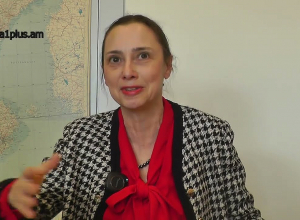
In an interview with "A1+", chief architect of Armenia Narek Sargsyan said that he shares that opinion.
-If we look at the Government building plan of Alexander Tamanyan, we see that it is a very democratic building because it is on the sidewalk, there are no gates and it is appropriate for the people. The Soviet system was transformed during the Stalin era. We currently live in an independent country and architecture will definitely portray the relationship between government and the people.
What do we see when we judge our history through the architectural buildings constructed since independence?
There was no soul in the architecture during the Soviet era and we see that with the many districts. But there were rules and regulations and that came from European urbanization, which came to Armenia through Russia. Tamanyan himself was a czarist, Russian architect. What did the collapse of the Soviet system bring to Armenia? We complain about everything, including architecture. We fell back to Asia with one stroke of a pen.
We are doing everything we can to draft the main plan, draw the plans for zones, and make attempts to return to our roots where urbanization began.
-Yes, but you can’t build a strong wall from rock that can be easily crushed. We can’t have the culture of architecture if there are no citizens. The citizen is not higher than the villager, but the village has its culture and the city has its own. Villagers are those who are materialistic and who only care about their piece of land. The person who is a bearer of the city culture doesn’t steal from the people and tries to keep the discipline of city building. Very few have that culture. During the years of the Soviet Union, the government made the decision and that was it, but there were no private lands. Now, everybody has the chance to build and here is where we see the difference in city and village cultures. Of course, there is a huge difference between now and the 90s and we see progress. I think that it will take a long time before we reach the level where urbanization will be looked at as pride of the nation or love for the homeland. People can express interesting ideas, but they need the resources to turn those ideas into reality. I don’t think that we have always had all resources and used them.
This refers not only to you, but the political will that hasn’t been manifested. In other words, it was allowed to ruin Yerevan.
-Nevertheless, political will expresses the will or desire of society.
You mentioned that there was no soul in Soviet architecture. Do you see the soul in today’s architecture, say, Northern Avenue?
-Northern Avenue is incomplete and I am not giving evaluations for that. When we add the greenery, install the statues, provide lighting and add the finishing touches, it will finally look like an avenue and then we can give evaluations. But what I can tell you is that many multi-story buildings are being built in central Yerevan with the Soviet mentality. At least the construction of Northern Avenue tries to keep the tradition alive. But there are still buildings that have no image. We have values that we must preserve and develop with certain traditions, for example, Dilijan, Jermuk, parts of central Yerevan, historical center of Gyumri, Tatev, Halidzor. We’ve begun construction to preserve what we have and make it develop in its own style.
How much time do we need to make the transition from Asian architecture to European architecture?
-We’ve already reached the point where the people feel it. The people are complaining and we see the results. We need to work in some courses and at the same time. First, the legislation must be restricted. I hope the law on “Yerevan” will help and the new model will help get urbanization back on its feet. That is why we need city building documents to reach each citizen. We need to draft and confirm all construction plans as a law and if we can do that, then all pressures and influences will not be able to change the law. For example, we have taken on the responsibility to draft the rules and regulations for building in Dilijan and Jermuk. We are making a construction plan for Jermuk for the first time. The plan will be drafted and nothing else will be allowed. Subjective factors come into play when there are no plans.
Interview by Diana Markosyan