Caucasus issues in a Caucasus court?
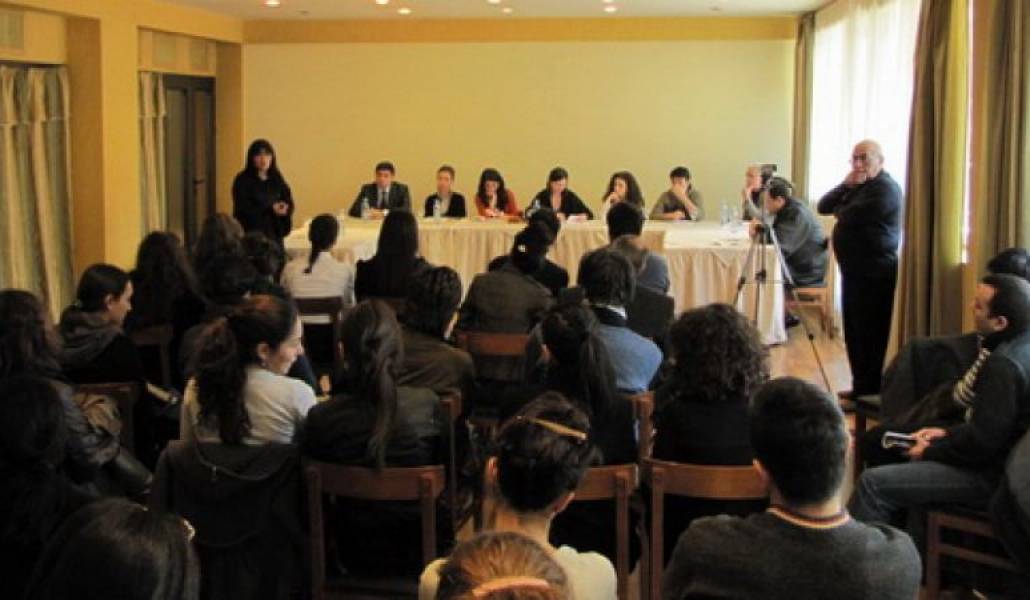
An Azeri advocate filed an appeal against Russia in defense of the Chechens. A Georgian advocate represented Russia's interests and justified Russia's actions during the Russian-Chechen conflict. "Leila Madatli versus the Opponents of Administering International Justice in Connection with the Chechen conflict"-this was the subsequent appeal at the Caucasus Symbolic Court of Human Rights.
It was the first symbolic trial in English because all previous trials had been in Russian. Representatives of Armenia and Azerbaijan had traveled to Georgia to participate in the trial. The Armenians, Georgians and the Azeri sat in the judges' chairs, but they were not the ones reaching the verdict, rather...the audience (The audience was not very active this time and, according to the organizers, perhaps they were afraid of expressing themselves in English). The verdict reached by the participants during the nearly one-hour trial held at the "Varazi" hotel
in Tbilisi favored the plaintiff.
This symbolic trial was organized with support from NED and by the Alliance of Women for Civil Society (Azerbaijan), the Caucasus Center of Civil Hearings (Georgia) and the Caucasus Center for Peace-Making Initiatives (Armenia).
After the trial, "A1+" talked to initiator of the symbolic trials and hearings,Program director and professor, Niazi Mehti. According to him, before the "Caucasus" trials, they had held Symbolic Constitutional Trials in Azerbaijan for 5-6 years. In fact, the NGO was even called "Symbolic Constitutional Court". This organization has organized a number of demonstrations in Azerbaijan in the 1990s and at the time, according to Mr. Mehti, the idea was born to discuss violations of human rights in the format of a debate between plaintiffs and defendants.
When he came across the materials of the Inter-American Court of Human Rights at the Uppsala Library in Sweden, the professor thought: "If America is replicating the experience of the European court, why can't we do that symbolically?"
Could the symbolic trials become a model for creating a Caucasus Court of Human Rights? In response, Mr. Mehti said: "Of course they can. Our project is justified in that democracy in the Caucasus is not at the point where there can be a Caucasus Court of Human Rights. But we must work towards that and our Symbolic Trials may become a Major Experience." By the way, there is no restricted procedure for selection of themes for the trials.
In its upcoming trials, the Symbolic Court will discuss, for example, the Georgian law on repatriation of Meskheti Turks and the trial will be held in Baku. The right to self-determination of nations is also on the agenda and in this case, the plaintiff will be an Azeri, while the defendant will be a Swedish Armenian.
Is it possible to hold such a Symbolic Trial in Yerevan?
"It would be ideal to hold the trials successively in Baku, Tbilisi and Yerevan. I hope that this will soon turn into a reality. That is when we will set forth issues about more in-depth phenomena," said Professor Niazi Mehti.