If you love...: Young man unable to walk since childhood speaks out against stereotypes (video)
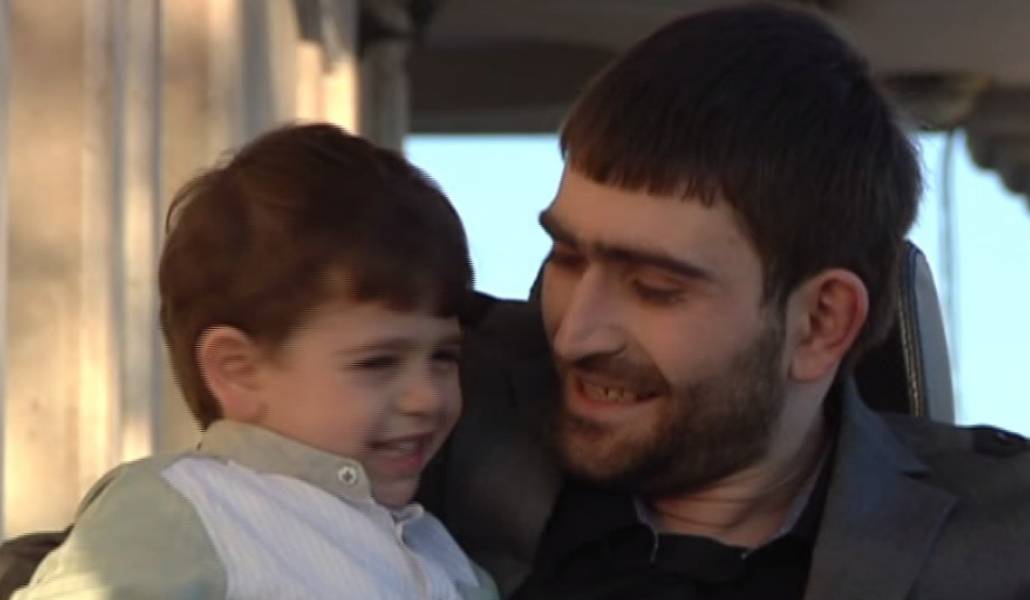
Hovhannes Grigoryan, 26, occasionally sits in the balcony of their house in the village of Kasakh to reflect on his achievements and failures. But he does not stay in solitude for a log time. His privacy is always disturbed by his three-year-old nephew, Mher, who is the favourite of his uncle. Hovhannes, who has been unable to walk since childhood, has not been discouraged by the difficulties in life. Still an 11-month-old baby, he developed polio, a disease that left him without the full use of his legs.  Treatment in Armenia and abroad has not produced any results. Hovhannes lives with his parents and his brother’s family. He has always felt the love of his relatives and friends who have helped him overcome numerous problems on his way. Hovhannes, in turn, has always delighted them with his cheerfulness and optimism.
  Since childhood, Hovhannes has been interested in recording devices and computers. After leaving school he learnt video editing. In 2015, he attended a course of TV skills organized by Ordfilm Company. However, he has been unable to find a job. Hovhannes remembers a job interview especially well when he impressed the employer with his knowledge. “The next day we were told that four candidates had been recruited by the company. I was told that my disability was not a problem but later I was informed that they could not do anything [about it],” Hovhannes recalls. He has always seen his disability as an obstacle in getting a job. “The state should first of all solve the problem of wheelchair lifts and ramps, create workplaces so that disabled people can feel as full-fledged members of society and be able to work like many others,” he continues. Hovhannes is surprised at the prevailing stereotypes in society. Getting around in a wheelchair is not an obstacle in establishing friendly or labour relations with others or in achieving success in any sphere. He says employers, in particular, have a wrong idea about disability. "They think that people with disabilities cannot do anything, cannot work or be useful. But they are mistaken. I studied alone and was able to fully master computer skills. Today I am ready to work by profession, my education corresponds to it,” he says. In 2014, the RA Law on Employment included a quota for the employment of people with disabilities. The law refers to public and private sector companies with a staff of 100 people and more. The quota is set at 3 % for civil service staff and 1% for that of the private sector. The public sector has partially fulfilled the requirement while the private sector is to meet this requirement in 2016. It is foreseen that at least one hundred people with disabilities will be provided with jobs this year. “This is the minimum figure because there are organizations that have not fulfilled the requirement to fill 3% of their jobs with disabled employees,” said Tadevos Avetisyan, Head of Labour and Employment Department at the Ministry of Labour and Social Affairs. All organizations and companies are to comply with the mandatory quota of workers with disabilities until next February otherwise they will be subjected to liability. “Companies that will fail to meet this requirement will be fined 300,000 drams for each job,” Mr Avetisyan added. If deductions are not made as of their due date, the company will be fined in the amount of 0.15 % for each day. No assistance is foreseen under the state program for meeting the quota requirement. According to official figures, 3-million-strong Armenia has more than 200 000 disabled persons. About 2 200 people with disabilities found jobs in 2015 with the help of different state assistance programs. Another 2 000 disabled persons are currently registered at the State Employment Agency as job seekers. “Surely, these figures are more modest than the problem is. But the most important is that, these are definite programs which have a tendency to grow,” said Tadevos Avetisyan. Executive Director of Unison NGO Armen Alaverdyan accounts the positive development for the active struggle of NGOs. “There was great controversy over these quotas and strong opposition by some government agencies for some unknown reasons. Anyway, we were able to overcome it,” Mr Alaverdyan said. In the meantime, Hovhannes Grigoryan hopes that the government will eventually solve the issue of employment of persons with disabilities and these people will actually be employed in Armenia. Permanent employment will also help Hovhannes to quickly arrange his personal life. His girlfriend is always there to second and encourage him… "There is a stereotype that girls will not want to marry disable people. But it is wrong because if you love someone you will not pay attention to anything;his disability will not matter. I consider myself to be a full member of society who can, like many others, have a family, children and live a happy life. And I definitely need a job to form a family," Hovhannes said. He would also like to get permission to drive a car. Hovhannes can drive but he cannot go on long journeys for he does not have a driving license. “I wonder how they can give a license to someone who has serious problems with vision and refuse it to a wheelchair user who cannot use his legs but can drive with hands,” Hovhannes says. Anyway, Hovhannes is not discouraged by the difficulties and advises everyone to follow his example. "I always look ahead. I do not want people with disabilities to be disappointed in their lives. Life does not end there, you need to be strong enough to be able to overcome everything," he says in conclusion.

 This program is maintained within the framework of Media for Informed Civic Engagement project that is made possible by the support of the American people through the United States Agency for International Development (USAID). The contents are the sole responsibility of the authors and do not necessarily reflect the views of USAID or the United States Government.