ENVIRONMENT PROTECTION HAS NO BOUNDERIES
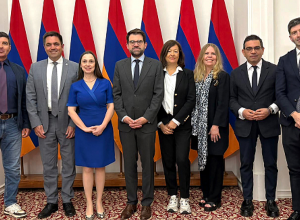
Support A1+!A number of Armenian, Azeri and Georgian journalists met in the Georgian city of Shindis to discuss the issues of environment protection and to find common ways of cooperation.
The Armenian and Azeri journalists focused on the issue of mingling environment problems with political ones. They debated on the rivers bordering the two countries. As we know the Azeri side is constantly complaining that Armenia deliberately pollutes the rivers flowing through Azerbaijan, whereas Armenia claims that there is no evidence to prove it. The point is that the monitoring is not perfect in either country, and the water quality of the neighboring country is unknown. “Environment issues are often made political. These issues often become the theme of such seminars but they always remain insolvable,” noted Arevhat Grigoryan, an Armenian specialist. Lilit Haroutyunyan, program coordinator of the environment issues of the Caucasian region, added that the matter will find its practical solution lest the countries shift the matter to political sphere. “There is no political dialogue between the two countries, and environment is beyond politics,” she said.
The Caucasian countries have got similar environmental problems – the main concerns in Armenia, Georgia and Azerbaijan are wood cutting, wastes, and common utilization of the water pool.
The two-day seminar entitled “Assistance of political community, state and mass media into the ecologic dialogue” and initiated by the environmental protection centre of the Caucasian region was aimed at revealing the common problems of the countries under question as well as at finding ways for journalists to render assistance to countries, NGOs and business sector. The journalists came to the conclusion that the faults and shortcomings of the sphere are the same in the three countries; the state bodies violate the laws regulating the environment sphere, there are not willing to provide information and sometimes we come across people in the sphere who are unaware of the environment sphere and its problems.
“The state bodies, mass media and NGOs are on the way of development and such debates will contribute to all sides,” noted Souren Deheyan, representative of “Armenian Now” electoral weekly. By the way, the journalists confessed that sometimes the journalist turns out to be unaware of the problems of the sphere himself; he doesn’t understand the information of the source properly or delivers it to the audience in wrong way. “Eco-journalism is not so authoritative. In fact there is an urgent need of serious and literate journalists. Journalists can prevent new ecological calamities,” said manager of the program Lela Janashia.